
When recording transactions, you must know the nature of the transaction and how it affects the accounts of the business. The person who makes a transaction is rarely the same person who records the transaction, so accurate and descriptive source documents are important. Most transactions are easy enough to record. Here is an example.



A proprietorship business account is low on cash. The business owner writes a personal check for $10,000 for deposit in the checking account of his business. Follow the steps for recording this transaction:
1. The business owner hands a personal check to the bookkeeper. The bookkeeper prepares a receipt, #c201, giving a copy to the owner and keeping a copy for the business.
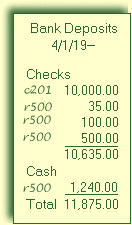
2. The bookkeeper includes this check in the bank deposit for the day (shown below). All sales for the day have been recorded on a single source document, #r500. Notice that this deposit slip does not tell you that #c201 is a check from the owner. If the bookkeeper recorded that $10,000 as a sale, the business's income and financial situation would be overstated by that amount. This is why you always use original source documents to record transactions. Recording from the deposit slip and making an assumption that the #c201 receipt is a big sale would be a costly error.
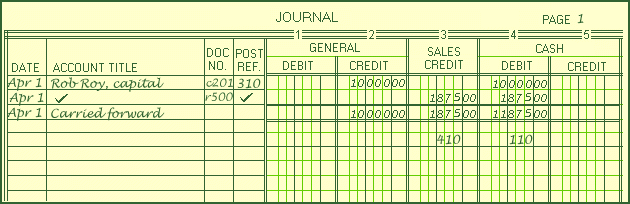
3. The receipts matching the bank deposit are recorded in the journal (shown below). The owner's investment increases the assets of the business, so that transaction is a credit to capital and a debit to cash. Sales also increase the assets of the business, so those transactions are also a credit to capital and a debit to cash. In this case, the capital account affected is sales. This journal shows how it looks after amounts are transferred to the ledger. Sales, as shown in this journal, often have their own column. This saves time by allowing for one total to be transferred to the ledger account, instead of numerous individual sales amounts. (Imagine this journal contains many transactions that are transferred to the ledger every day, week, or month.) Notice that cash is handled the same way. Instead of transferring each individual transaction, the column is totalled and just the total is transferred. The account number below the total serves as a POST REF.
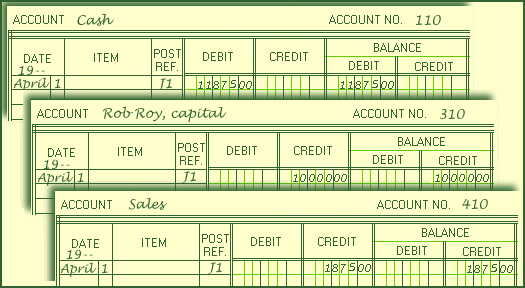
4. Journal entries are posted to the ledger accounts.
From the ledger accounts we can determine the financial condition of the business by creating financial statements. Note that in the Journal and in the Ledger, debits always equal credits.
Recording transactions is as simple as following these steps. Note that each document references another document, leaving a trail from source to final total on a financial statement. In this example, the bank deposit is not the original source document, but might serve as a summary of the receipts for the day and the source documents could be attached, the whole filed away for reference. The source documents in this case are a check receipt (c201) and a sales receipt (r500). If bank deposit slips were filed separately and you needed to verify the source of the deposit, you could easily find the source documents because they are noted on the slip. If you were looking at the Ledger and wanted to verify the source of the $11,875 posted to cash, you look at the POST REF. column containing "J1," which means page 1 in the Journal, go to page 1 of the Journal and see that the total of receipts for April 1 was posted. From here you can look at the DOC. NO. column and retrieve the original source documents from a file.
When transactions are properly recorded, accounting is easy, and informed decisions can be made by business owners on the basis of their accounting reports. When transactions are not properly recorded, accounting can become a mess and business owners cannot make informed decisions.
URL: http://www.aislingobair.com/bk05.htm
Copyright © 1997-2026 Kathleen A. O'Connell, ALL RIGHTS RESERVED.
Last updated 1/5/26
Copyright © 1997-2026 Kathleen A. O'Connell, ALL RIGHTS RESERVED.
Last updated 1/5/26